

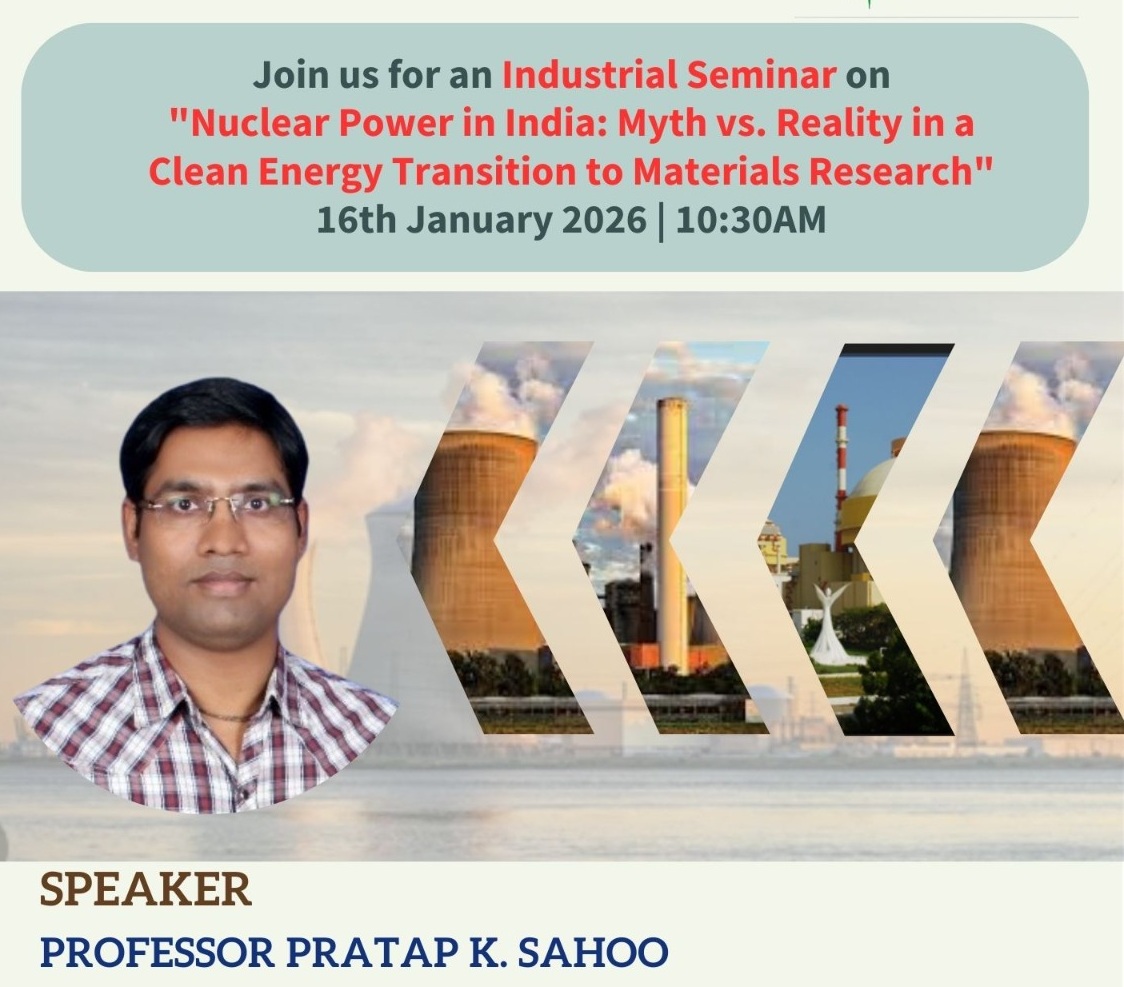
Industrial Seminar on 16th January 2026
Expert details
Professor Pratap K. Sahoo
School of Physical Sciences
Ion Beams and Nanomaterials Laboratory,
National Institute of Science Education and Research
(NISER) Bhubaneswar, Jatni -752050, Khurda, Odisha,
INDIA
Name of the Topic
Nuclear Power in India: Myth vs. Reality in a Clean Energy
Transition to Materials Research
Objective
Venue
SDI-Auditorium
Date & Time
16/01/2026 & 10.30 am
Objective
Assess Perceptions vs Facts About Nuclear Power
nuclear power in India (e.g., safety concerns, cost, waste) and
juxtapose them with evidence-based realities.
benefits, limitations, and risks in India’s energy context.
(This reflects the “myth vs reality” framing such papers use.)
Examine Nuclear Power’s Role in India’s Clean Energy Transition
or clean energy transition, including its potential to replace or
complement fossil fuels like coal.
reliable electricity that supports climate goals like net-zero
emissions.(Similar to research showing nuclear is included in India’s
decarbonization conversations due to its low emissions and
baseload capability.)
Compare Nuclear with Other Clean Energy Sources
in terms of land use, energy density, reliability, intermittency,
cost, and scalability.
India’s energy mix in light of renewables’ growth.
(Comparative studies often frame nuclear’s strengths and
weaknesses relative to renewables.)
Highlight Policy, Economic, and Technological Dimensions
in India, including investment, safety regulation, and public
acceptance.
breeder reactors, potential SMRs) and fuel cycles relevant to
India’s long-term strategy.
(Many India nuclear energy articles examine technological
pathways and policies.)
Inform Energy Strategy and Research Directions
technology development, or strategic decisions that help integrate
nuclear into India’s future energy roadmap.
public perception challenges through research and outreach.
Targeted Audience
Students pursuing ITI, diploma, or degree programs, as well as
individuals from industry or institutional backgrounds.
Registration fee
The fee for students is set at INR 100, while the charge for
individuals from industrial or institutional backgrounds is INR 300.


